
Not because anything necessarily went wrong, but because some spaces simply ask more from the people living in them. Certain finishes show every mark. Some layouts create corners that are difficult to clean. A small repair may require removing several other pieces just to reach what needs attention.
Other renovations seem to settle into daily life much more comfortably.
That difference is worth thinking about before the work begins.
Maintenance starts with the decisions you barely notice
When homeowners picture a renovation, they naturally focus on what they will see: cabinetry, flooring, countertops, tile, lighting, paint colors and fixtures.
But how easily a room can be maintained often comes down to quieter decisions.
How many seams are there? Are there narrow spaces where dust and debris will collect? Can commonly used areas be reached without moving half the room around? If one component eventually needs attention, can it be dealt with without disturbing everything around it?
These are not the glamorous parts of a remodel, but they can have a surprisingly large influence on how the finished space feels to live with.
More detail is not always more practical
There is nothing wrong with decorative detail. In the right home, it can give a room character that a simpler design would never have.
But every additional groove, ledge, transition and material change can also become another surface that needs attention.
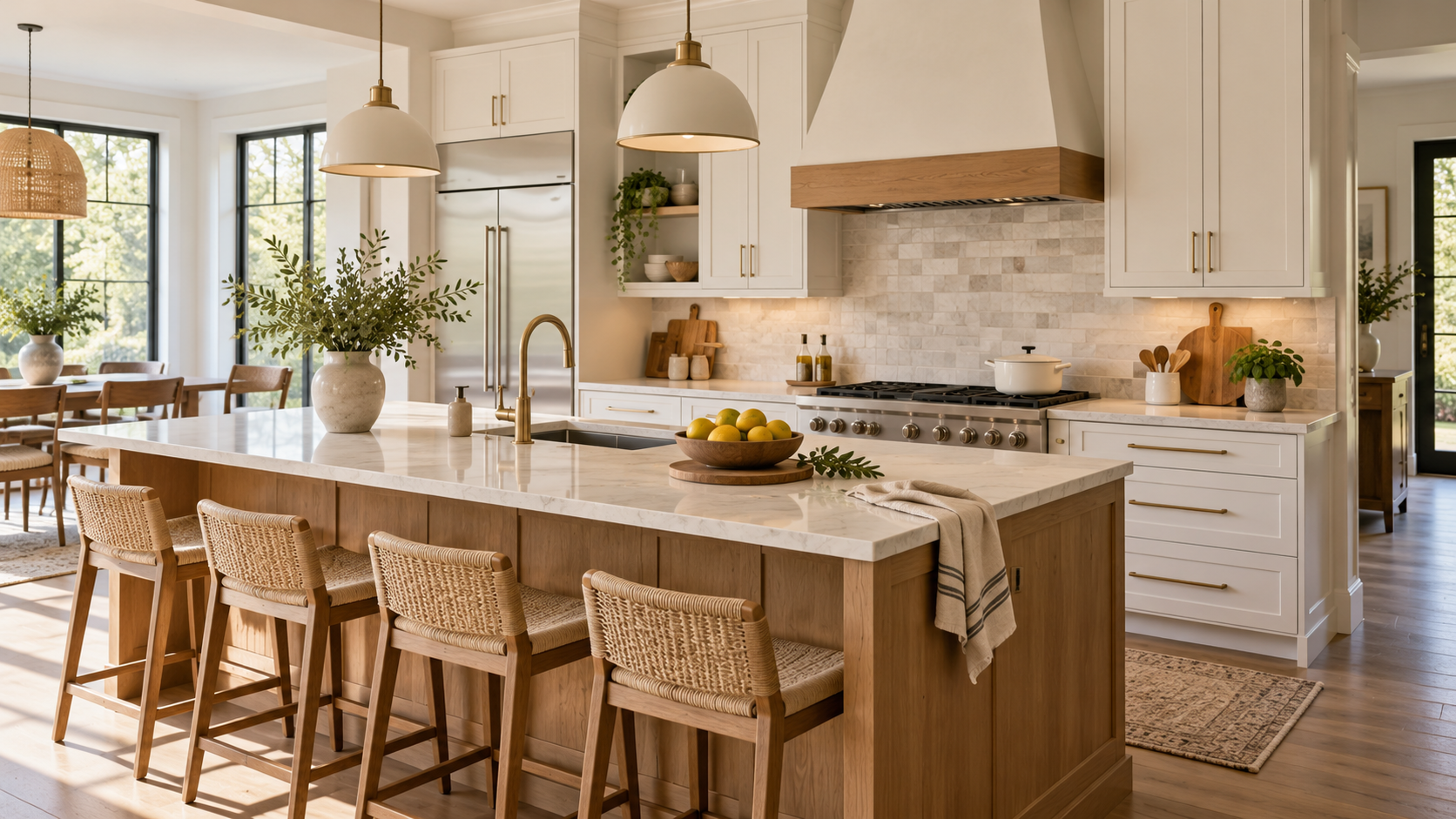
A kitchen with multiple countertop materials, ornate cabinet details and several types of backsplash may create a dramatic first impression. A simpler design might ask less of the homeowner on an ordinary Tuesday evening when the goal is simply to clean up dinner and move on with the night.
Neither approach is automatically better. The important question is whether the level of detail suits the way the homeowner actually wants to live.
Materials should make sense beyond the showroom
A sample can tell you how a material looks. It cannot completely show you what living with it will feel like.
Some homeowners enjoy surfaces that develop character as they age. Others would rather choose something that continues looking relatively consistent without much fuss. Some do not mind regular upkeep if a particular material gives them exactly the appearance they want.
That is why “low maintenance” is not really one universal style.
It is a match between the material and the person who will be living with it.
A finish that feels perfectly manageable to one household may feel unnecessarily demanding to another.
The easiest rooms often have fewer awkward places
Good maintenance is also connected to layout.
Think about the small spaces that are routinely ignored until they become annoying: the narrow gap beside an appliance, the tiny strip between a vanity and a wall, or the corner that can only be reached by getting down on the floor with a vacuum attachment.
Individually, none of these is a major problem.
Collect enough of them in one room, however, and the space can begin to feel harder to care for than it should.
During a renovation, thoughtful dimensions and transitions can sometimes eliminate those awkward leftovers altogether. The finished room may not look dramatically different because of it, but living in it can feel noticeably easier.
Think about what happens when something eventually needs attention
A home is not a museum. Things get used.
Hardware loosens. Paint gets marked. Appliances eventually change. Fixtures may be replaced. Families use rooms differently as the years pass.
A practical renovation leaves some room for that reality.
This does not mean designing a home around everything that might possibly go wrong. It simply means remembering that the finished photograph is not the end of the story.
A renovated room should still make sense after it has been lived in.
Storage quietly changes how much work a room creates
Sometimes what appears to be a maintenance problem is actually a storage problem.
When everyday items do not have an obvious place to go, countertops become crowded, bathroom surfaces collect bottles, and frequently used rooms begin to feel messy almost immediately after they have been cleaned.
Useful storage does not necessarily mean adding cabinetry everywhere.
It means paying attention to what actually lives in the room.
A kitchen used by a family that cooks every night needs something different from one used mostly for coffee and takeout. A primary bathroom shared by two people has different storage demands from a small guest bath.
Designing around real habits can make a renovated space easier to reset at the end of the day.
The best kind of low maintenance is the kind you stop noticing
Most homeowners probably do not want to walk into a newly renovated room and think, “This will be easy to maintain.”
They want to think about how good the room feels.
That is exactly the point.
When the practical decisions have been considered carefully, maintenance does not need to become the personality of the design. The room can still feel warm, detailed, modern, traditional or completely individual to the homeowner.
It simply asks for less attention once everyday life moves back in.
That can mean fewer annoying corners, sensible storage, finishes that suit the household, and design choices that still feel reasonable after the excitement of the renovation has passed.
Design for the years after the reveal
Renovating a home naturally involves thinking about how it will look when the work is complete. It is worth spending a little time imagining the years that come afterward too.
What will this room be like to clean? Where will things go? Which areas will get the most use? Will the materials still suit the household when the space is no longer brand new?
The National Association of Home Builders also offers a homeowner remodeling planning resource for those beginning to think through a future project.
For EGM Construction, a successful renovation is about more than creating a strong first impression. It is about creating a home that continues to work comfortably after the contractors leave and ordinary life begins again.
If you are considering an interior renovation and want to talk through the possibilities for your home, contact EGM Construction to start the conversation.