
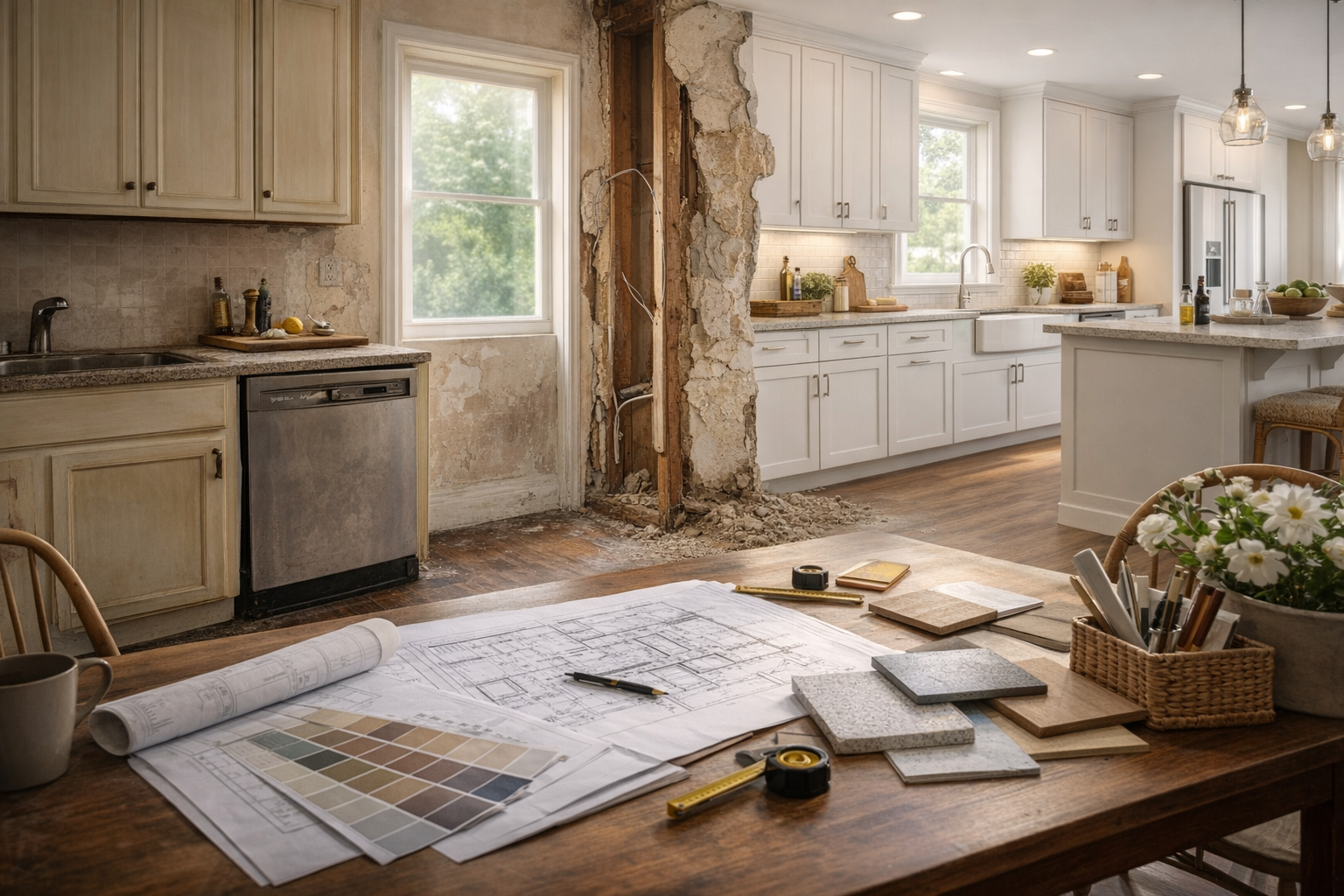
Sometimes a home simply needs updating. New surfaces, better finishes, improved lighting, and more cohesive design choices can make the space feel current again.
Other times, the problem runs deeper. The issue is not just how the home looks. It is how it works. The layout feels inefficient. Storage is always lacking. Traffic flow is awkward. Certain rooms no longer support the way the family actually lives. That is when a home may need reworking, not just updating.
What “Updating” Usually Means
Updating is often visual, surface-level, and finish-driven. It improves the feel of the home without significantly changing how the structure or layout functions.
This might include replacing old flooring, repainting walls, updating cabinetry fronts, installing new countertops, changing fixtures, or improving lighting. These changes matter. They can make a home feel cleaner, brighter, more modern, and more in line with the homeowner’s style.
A home that needs updating is usually still functioning reasonably well. The frustration is often aesthetic, not structural or spatial.
What “Reworking” Usually Means
Reworking is a different category of renovation. It is not mostly about appearance. It is about correcting how the home performs.
A rework may involve shifting the layout, improving circulation, opening sightlines, adding storage where none exists, adjusting room relationships, or addressing older systems that no longer support present-day use.
In these cases, new finishes alone do not solve the core frustration. A beautiful room can still feel wrong if the layout continues fighting the people who use it every day.
A Useful Question: Is the Problem Visual or Behavioral?
One of the clearest ways to tell the difference is to ask whether the room mainly looks dated, or whether it regularly creates friction.
A dated bathroom may need updating. But a bathroom that feels cramped, lacks practical storage, has poor ventilation, or forces awkward movement may need reworking.
A kitchen with older finishes may benefit from cosmetic upgrades. But if the cooking zone is disconnected, the storage is constantly overflowing, and several people cannot move through it comfortably, the issue is no longer cosmetic.
Homes reveal their true problems through repeated behavior. If the same inconvenience shows up every day, the answer is often deeper than paint or tile.
Signs a Home Probably Just Needs Updating
In many homes, the bones are still doing their job. The layout works. The space feels usable. Nothing major is failing. It simply feels visually tired or behind the times.
Common signs include worn finishes, dated materials, old fixtures, faded paint, or inconsistent design choices that make the home feel older than it is. These are often excellent candidates for a well-planned update.
According to the National Association of Realtors Remodeling Impact Report, many homeowners report strong satisfaction from projects that improve daily enjoyment, even when the underlying structure stays the same.
Signs a Home May Need Reworking Instead
Reworking usually becomes necessary when the house keeps creating the same functional problem over and over.
That can look like narrow walkways, poor room connections, inadequate storage, low natural light in the wrong places, outdated electrical capacity, or layouts built for a different era of living.
The Harvard Joint Center for Housing Studies has consistently highlighted how homeowners are placing more value on usability, adaptability, and long-term livability. That shift matters. People are no longer renovating only for appearance. They are renovating for the way life actually feels inside the home.
Why This Difference Matters Before You Start
Misdiagnosing the problem is one of the easiest ways to overspend. If a home needs reworking but only receives cosmetic updates, the homeowner often ends up disappointed. The room may photograph better, but it still lives badly.
On the other hand, some homeowners assume they need a major overhaul when a thoughtful update would have solved the issue beautifully and far more efficiently.
The goal is not to make every project bigger. The goal is to make it more accurate.
How EGM Construction Helps Clarify the Right Path
At EGM Construction, we help homeowners sort through that distinction before work begins. Sometimes the answer is a refined update. Sometimes it is a deeper rework that creates lasting relief and better flow.
The important part is understanding what the home is really asking for — not just what looks appealing on the surface.
If you’re starting to feel like your home no longer fits the way you live, visit our contact page to schedule a consultation and talk through what kind of renovation actually makes sense.