
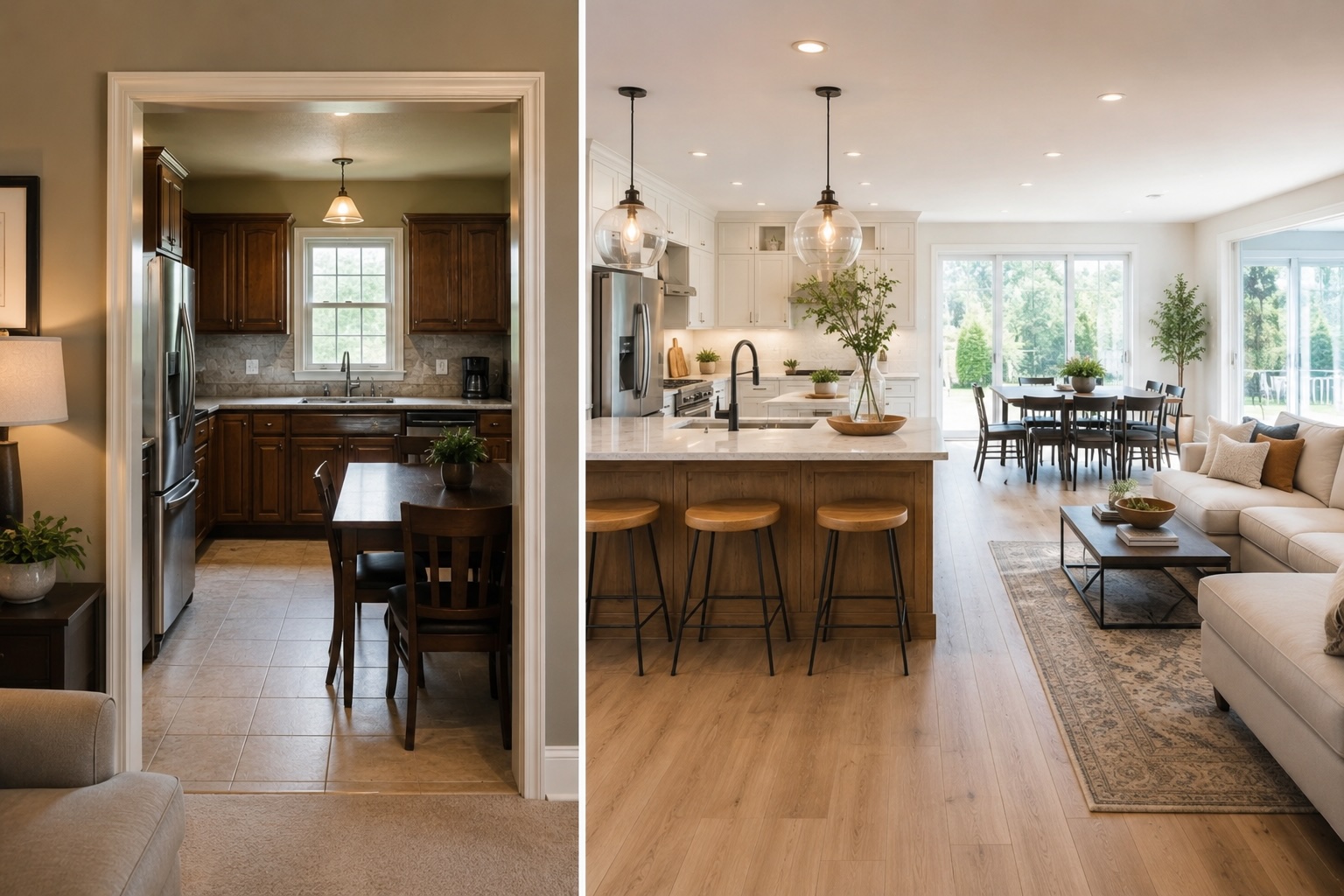
Open layouts can be beautiful, but they are not the right solution for every home or every lifestyle. Before removing walls, it helps to understand what open concept actually changes.
For years, open-concept living has been one of the most requested renovation goals. Homeowners imagine brighter spaces, better sightlines, and a home that feels larger than its square footage suggests.
And sometimes, that is exactly what happens.
But after enough time around remodeling projects, one thing becomes clear: removing walls does not automatically solve a home’s problems. In some cases, it creates new ones.
The conversation should not be whether open concept is good or bad. The better question is whether it is right for the way a particular household actually lives.
Why Open Concept Became So Popular
There are good reasons open layouts became desirable. Many older homes were designed around separate rooms and clearly defined functions. Kitchens were isolated. Dining rooms sat apart from living areas. Walls divided spaces that families now tend to use together.
Opening those spaces can create better visibility, improve natural light, and allow people to interact more easily throughout the day.
The National Association of Home Builders has noted that open layouts remain a major preference in residential design because they support flexible living and shared family spaces.
The key word is support. The layout should support how people actually use the home.
More Space Is Not Always Better Space
One of the most common surprises homeowners experience after opening a floor plan is realizing that larger does not always mean more comfortable.
Walls do more than divide rooms. They create definition. Without those boundaries, furniture placement becomes more challenging. Storage opportunities disappear. Noise travels farther. Activities that once happened independently can start competing with one another.
A room can feel larger while becoming harder to use. That is not a design failure. It is simply a reminder that square footage and functionality are not the same thing.
The Hidden Cost of Losing Walls
When people think about removing walls, they usually picture the visual result. What often gets overlooked is everything those walls were quietly doing.
Walls can provide:
- Storage opportunities
- Sound separation
- Privacy
- Defined traffic patterns
- Space for electrical systems
- Locations for artwork, shelving, and furniture placement
Removing a wall may improve one aspect of the home while creating challenges somewhere else. The goal is understanding that tradeoff before construction begins.
Families Live Differently Than They Did Ten Years Ago
An interesting shift has happened in recent years. While open concept remains popular, many homeowners are now asking for something slightly different.
They want connection without losing flexibility.
Remote work, online learning, multigenerational households, and changing daily routines have increased demand for spaces that can adapt throughout the day.
The Harvard Joint Center for Housing Studies has reported growing homeowner interest in remodeling that improves usability, adaptability, and long-term livability.
In practical terms, many families now want rooms that can occasionally be closed off when needed. Privacy has value too.
When Open Concept Works Well
Open layouts can work beautifully when the existing home feels dark, disconnected, or boxed in. In those situations, removing or adjusting walls can improve both comfort and function.
Open concept may be a strong option when:
- Natural light is limited
- Sightlines between rooms are poor
- The household enjoys shared cooking, dining, and gathering spaces
- The existing rooms feel disconnected from one another
- The home already has adequate storage elsewhere
In these cases, opening a floor plan is not about following a trend. It is about solving a real problem in the home.
When It Might Not Be the Best Choice
Open concept can be less effective when the home already struggles with noise, limited storage, or a lack of privacy. Removing walls may make those issues more noticeable.
An open layout may not be ideal when:
- Noise is already a concern
- Storage is limited
- Multiple people work from home
- Privacy is important
- The existing layout already functions well
Sometimes the better renovation is not removing walls. Sometimes it is improving flow, increasing storage, enhancing lighting, or reworking specific areas while preserving the advantages the existing layout already provides.
The Best Layout Is the One That Fits Your Life
There is no universally correct floor plan. A young family, a retired couple, and a multigenerational household may all need something different from the same amount of space.
The most successful renovations begin with understanding how people actually live inside the home, not how they think they are supposed to live inside it.
At EGM Construction, these conversations happen before any wall comes down. Understanding daily routines, frustrations, and goals often reveals solutions that are not obvious from floor plans alone.
Looking Beyond Trends
Design trends come and go. A home stays with people much longer.
Before pursuing an open-concept renovation, it helps to ask a simple question: will this make the home easier to live in every day?
If the answer is yes, it may be the right move. If the answer is uncertain, there may be other ways to improve the space without removing what already works.
If you are considering a renovation and want help evaluating your options, visit our contact page to start the conversation.